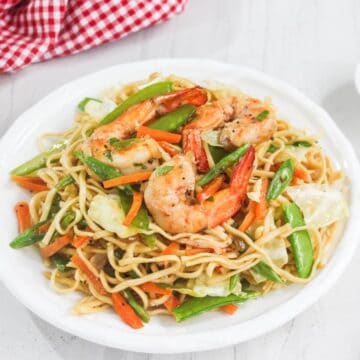
Filipino Shrimp Pancit Canton
Enjoy tender shrimp, crisp vegetables, and flavorful noodles in this easy shrimp pancit canton, perfect for family meals or gatherings.
Servings (Adjustable):
Calories: 415kcal
Save Recipe
Share on Facebook
Share on X
Ingredients
- 1 pound large shrimp 18 pieces, shell and head intact
- Homemade shrimp broth see below
- 3 tablespoons refined coconut oil
- 1 large onion 1 cup, finely chopped
- 3 cloves garlic minced
- 80 grams snow peas tips and string removed
- 110 grams carrots 1 heaping cup, cut into strips
- 100 grams green beans ¾ cup, tips and strings removed, thin bias cut
- 3 tablespoons soy sauce
- 2 tablespoons oyster sauce
- ½ teaspoon kosher salt add more to taste
- ½ teaspoon ground black pepper add more to taste
- 200 grams pancit canton
- 200 grams cabbage 2 heaping cups
- 1 teaspoon kinchay (Chinese celery) or regular clery diced
- 10 to 12 pieces fresh calamansi or lemon
HOMEMADE SHRIMP BROTH:
- shells and heads from the whole shrimp
- 2 ½ cups water or more if needed
- ½ tablespoon soy sauce
- kosher salt
- ground black pepper
Instructions
- Remove the head and shell of each shrimp, then place on a deep pan. Add salt, black pepper, soy sauce, and water then bring to a boil at 536°F (280°C) for 30 seconds. Turn down the heat to 140°F (60°C), stir, and simmer for 5 minutes and skim the foam.
- Turn off the heat after 5 minutes and steep the shells and heads for a few minutes, then strain. Reserve the shrimp broth and discard the shells and heads.
- While the head and shrimp are simmering, pat dry, devein, and season the peeled shrimp, then marinate for at least 15 minutes.
- In a deep heated pan with oil but not smoking, add seasoned shrimp and lightly cook half a batch of shrimp for 1 minute on each side. Immediately transfer to a paper-lined plate and cook the remaining batch of shrimp.
- In the same deep pan, sauté the onions for 2 minutes over low heat, then add garlic. Continue to sauté until the garlic is fragrant and onions are soft and translucent.
- Add the carrots and chicharo, then sauté for 1 minute.
- Add green beans, soy sauce, oyster sauce, salt, and black pepper, then sauté for 30 seconds. Add the slightly cooked shrimp and gently mix with the vegetables for 1 to 2 minutes until the vegetables are crisp tender and the shrimp are not overcooked. Transfer the shrimp vegetable mixture to a plate.
- In the same deep pan, pour the homemade shrimp broth and bring to a boil. Add the pancit canton and toss regularly as the noodles loosen. Pour soy sauce and oyster sauce, then simmer pancit canton for 3 minutes, while gently tossing the noodles.
- Season with salt and black, add more water if needed, and continue tossing the noodles. Once the noodles are slightly tender add the shrimp and vegetable mixture. Continue to toss until the noodles are tender while the shrimp and vegetable are heated through. Top with kinchay and serve immediately.
- Alternatively, transfer to a platter, sprinkle kinchay and serve.
- Cut calamansi in half and serve on the side.
Notes
Filipino Pancit, Canton and Bihon, are prepared all year round and constantly served during birthday celebrations, fiestas (feasts), and during the Yuletide season.
18 pieces of fresh shrimp were used in this recipe. If fresh shrimp is unavailable, use frozen shrimp, preferably with shell and head to make the homemade shrimp broth.
Do not overcook the shrimp and cook in batches.
Filipino Pancit is quick and easy to make once all the ingredients are ready. Preparation can be tedious if everything is peeled, sliced, and chopped, plus the homemade seafood stock is made on the same day as cooking the pancit.
If pressed for time, use store-bought seafood or shrimp stock while the shrimp can be peeled and deveined.
Traditionally, liver (pork or chicken) is added to Filipino Pancit but to keep it pescatarian, I omitted the liver.
If kinchay (Chinese celery) is not available, wansoy (coriander/cilantro), celery and parsley may be used. Kinchay is maybe celery-like in flavor, but most kinchay has a stronger flavor than celery (with stalk).
To balance the shrimp flavor and aroma, a generous amount of freshly squeezed calamansi juice is drizzled over the noodles before eating.
For some people, 1 piece of fresh calamansi is enough for 1 serving of pancit canton. For some, 3 or more fresh calamansi are used per serving of pancit canton. The number of calamansi pieces may vary depending on their sizes.
Pancit Canton’s cooking time can vary depending on the brand, the pan used, and the heat of the boiling water. Test the tenderness before adding the shrimp and vegetable mixture and do not overcook.
Calamansi is also known as calamondin and Philippine lime.
Nutrition
Calories: 415kcal | Carbohydrates: 51g | Protein: 24g | Fat: 13g | Saturated Fat: 9g | Polyunsaturated Fat: 1g | Monounsaturated Fat: 1g | Trans Fat: 0.01g | Cholesterol: 143mg | Sodium: 2249mg | Potassium: 494mg | Fiber: 5g | Sugar: 6g | Vitamin A: 5244IU | Vitamin C: 39mg | Calcium: 130mg | Iron: 2mg
Equipment
